

Angel Face (1952)
- nmojtahed
- Jul 14
- 3 min read

Updated: Jul 15
The dark world depicted Otto Preminger
Angel Face revises these concerns. Preminger subverts the classic femme fatale archetype by replacing greed and financial gains with obsession as the source of female sinister power. Diane (Jean Simmons) is motivated not by material gain but by her pathological attachment to her father, Charles Tremayne (Herbert Marshall), which has created her overwhelming hatred of her stepmother. After her mother’s death in an air raid, Diane transfers all her emotional needs to her father, leaving her incapable of accepting another woman in his life. When he marries the wealthy socialite Catherine (Barbara O'Neil), he effectively trades his creative work for the comfort of living off his wife’s fortune.
Diane, however, refuses to recognize that her father created the current situation and that his artistic failure has been a personal choice, trading his freedom for the comfort of a life with no financial concerns. Instead, she displaces his shortcomings onto her stepmother. Within this context, Preminger transforms the femme fatale from a calculating opportunist into a psychologically damaged and deeply tragic persona whose crimes stem from emotional obsession rather than material ambition.
In Laura, Preminger explores male sexual fantasy through a detective who falls in love with the portrait of a woman. In Vertigo (1958), Hitchcock looks at another version of the same dream.
Preminger also renders the two principal male characters morally compromised. Diane’s father, as noted above, sacrifices his independence by marrying into wealth, and with his emotional shortsightedness, encourages his daughter’s pathological attachment without perceiving its destructive consequences for Diane and Cathy. Frank Jessup (Robert Mitchum) initially appears to be the familiar hardworking noir protagonist, yet he proves equally tainted. His attraction to Diane reflects the same desire for social advancement that motivates her father’s marriage to Cathy. Early in the film, when he abandons the dependable Mary (Mona Wilton) without any real emotional connection to Diane, his true goal, climbing the social ladder, becomes clear. His masculine hubris leads him to assume Mary will be available whenever he wishes. Beneath his image of rugged masculinity lies the same moral weakness and self-interest that characterize Diane's father, reinforcing Preminger’s bleak vision of human frailty.
The movie has a circular pattern, Frank enters the mansion, the world of Diane, in an ambulance, he had a plan to exit the world on a different vehicle-the cab-yet it turned out to be a different car, he once wished to possess.
Preminger further departs from noir convention by dispensing with voice-over narration, minimizing night shooting, and avoiding overtly expressionistic visual techniques. Instead, he relies on long takes and deep-focus cinematography, presenting his characters with remarkable detachment and resisting explicit moral judgment. One of the most celebrated long takes follows Frank watching Diane at the piano. Critics have noted how this sequence exemplifies Preminger’s command of cinematic form: rather than relying on editing, he uses fluid camera movement and spatial composition to articulate themes of voyeurism, control, and emotional entrapment.
Preminger's fluid camera movements, long takes, and use of space to evoke his characters' cold world highlights mise en scène over editing, which was once thought to be the essence of cinema.
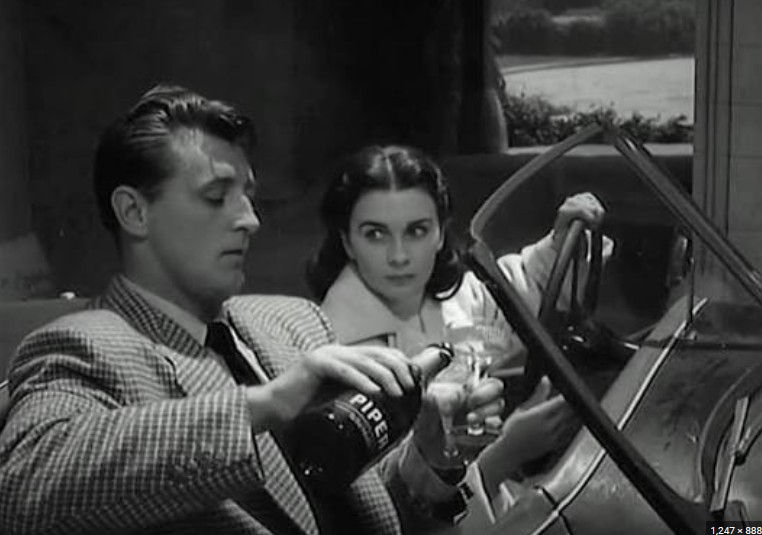
The final scene is arguably the film’s most memorable moment, in which Preminger brings together irony and noir fatalism with striking simplicity. Diane and Frank return home acquitted, with no redemption or punishment, and no moral commentary on their actions. Instead, Preminger shows how a seemingly trivial instant portends an explosive power. As a last attempt to hold onto Frank, Diane offers to drive him to the bus station. Frank, cold and irritated, to avoid further tension, concedes her offer, although he remains emotionally distant. When the car gives a sudden jolt as he tries to pour champagne, he momentarily loses control and snaps, “Watch it.” That flash of anger is enough: Diane silently changes her mind and shifts the car into reverse.
Preminger's mise en scene is distant, it only observes without rendering a commentary on the narrative's characters.
In the very last shot, the cab Frank had called pulls into the driveway. This image crystallizes several of the film’s central themes: (a) in keeping with noir fatalism, it stresses the futility of Frank’s efforts to escape his social circumstances; (b) from the moment he first followed Diane to the mansion, he has tried, and failed, to reintroduce elements of the world he formerly knew, and the cab marks yet an additional missed chance; and (c) the symmetry of vehicles is notable: Frank first enters this world in an ambulance and hopes to leave it in a taxi, but both vehicles arrive only to confirm his entrapment.


Comments